


If you’re thinking about adding physical gold or other precious metals to your retirement strategy, one of the first things you need to understand is Gold IRA fees. These costs can quietly chip away at your returns over time, and many investors don’t fully grasp how much they’re paying until they’re already in an account. Before you sign anything, understanding Gold IRA fees and getting a clear picture of every cost involved is essential.
This guide breaks down every cost you’re likely to encounter — from setup to storage to hidden charges most companies don’t advertise upfront. Whether you’re brand new to precious metals investing or just comparing providers, this article gives you the information you need to make a sound decision.
What Is a Gold IRA?
A Gold IRA is a type of self-directed Individual Retirement Account that allows you to hold physical precious metals — gold, silver, platinum, or palladium — as retirement assets. Unlike a traditional IRA, which holds stocks, bonds, or mutual funds, a Gold IRA holds tangible assets in a form the IRS specifically approves.
There are a few key players involved:
- Custodian: A financial institution (usually a trust company or bank) that the IRS requires to manage all self-directed IRAs. The custodian handles paperwork, transactions, and IRS reporting.
- Depository: An IRS-approved, insured storage facility where your physical metals are kept. You cannot store Gold IRA metals at home.
- Precious metals dealer: The company that sells you the gold or silver you put into the account.
Because Gold IRAs involve more complexity than standard IRAs — physical assets, specialized storage, and additional compliance — they also come with more fees.
Why Understanding Gold IRA Fees Matters
Let’s say you invest $50,000 into a Gold IRA and pay $1,000 per year in total fees. Over 20 years, that’s $20,000 in fees — not counting the opportunity cost of that money not growing. Even modest fees compound into high costs over a long retirement horizon.
Beyond the numbers, fee transparency is a major trust signal. Companies that clearly disclose their fee schedules are generally more reputable than those that bury costs in the fine print or reveal fees only after you’ve applied. Understanding Gold IRA costs also helps you compare providers on equal footing — a lower advertised rate doesn’t always mean a lower total cost.
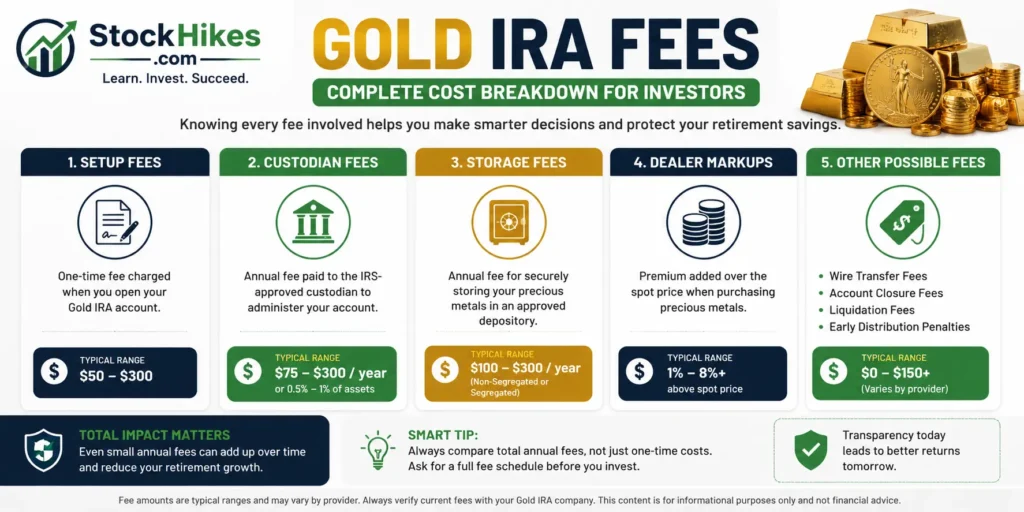
Gold IRA Setup Fees
When you open a Gold IRA, most custodians charge a one-time account establishment fee. This covers the administrative work of setting up your account, verifying your identity, and getting your account ready to receive a transfer or rollover.
Typical range: $50 to $300
Some companies waive this fee entirely as a promotional offer, especially for larger account balances. Others roll it into the first year’s annual fee. Either way, it’s a one-time charge — not something you’ll pay every year.
What to ask: Does this fee include the initial account application only, or does it also cover the first transfer or rollover processing?
Gold IRA Custodian Fees
Custodian fees — sometimes called administration fees — are the annual costs of having an IRS-approved custodian manage your account. The custodian is legally required for any IRA; you can’t self-custody a retirement account.
These fees cover:
- Maintaining your account records
- Preparing and filing IRS documentation (Form 5498, Form 1099-R, etc.)
- Processing buy and sell orders within the account
- Communicating with the depository
- Providing account statements
Two main fee structures exist:
| Structure | How It Works | Best For |
|---|---|---|
| Flat annual fee | Same dollar amount regardless of balance | Larger accounts |
| Scaled (percentage-based) | Percentage of total account value | Smaller accounts |
Flat fees are generally more favorable for investors with larger balances. For example, a $200 flat fee on a $100,000 account is 0.2%, while a 1% scaled fee on the same balance would be $1,000 per year.
Typical range: $75 to $300 per year for flat-fee structures; 0.5% to 1% annually for scaled structures.
Gold IRA Storage Fees
The IRS requires that all physical metals in a Gold IRA be held at an approved depository — not in your home or a regular bank safe deposit box. Storage fees pay for the secure vault space, insurance, and ongoing inventory management at these facilities. Among all recurring Gold IRA fees, storage costs are often one of the most important expenses investors need to evaluate.
Two types of storage:
Segregated storage means your metals are kept separately from other customers’ holdings, identified specifically as yours. It provides a higher level of assurance but typically costs more.
Non-segregated (commingled) storage means your metals are stored alongside other investors’ metals of the same type and purity. You own the equivalent amount, but not specific coins or bars. This option is less expensive.
Typical storage fee ranges:
| Storage Type | Typical Annual Cost |
|---|---|
| Non-segregated | $100 – $150 per year |
| Segregated | $150 – $300 per year |
Some custodians bundle their administration and storage fees into a single annual charge. Others bill them separately. Always ask for a breakdown.
Precious Metals Dealer Markups
When you fund a Gold IRA with physical metals, you purchase them through a dealer at the retail price — not the spot price you see quoted in the news. The spot price is the raw market value of the metal. The dealer markup (also called a premium) is added on top to cover their costs and profit.
Premiums vary based on:
- The type of product (coins vs. bars)
- Current market demand
- The dealer’s own pricing model
Examples of typical premiums above spot price:
- Gold bullion bars: 1% to 5% over spot
- Gold coins (American Eagle, Buffalo, etc.): 3% to 8% over spot
- Collectible or proof coins: Significantly higher, sometimes 20%+ over spot
This is not an ongoing fee, but it’s a real upfront cost. If you buy $50,000 in gold with a 5% premium, you’re starting with an effective cost of $52,500. Your investment needs to appreciate just to break even.
Tip: Stick to IRS-approved bullion products and avoid high-premium numismatic or collectible coins, which are often aggressively marketed but difficult to sell at a profit.
Gold IRA Transaction Fees
Beyond setup and annual fees, transactions inside your account may carry additional costs.
Purchase fees: Some custodians charge a per-transaction fee each time you buy metals. This can range from $10 to $50 per trade.
Selling fees: When you sell metals within the account (for example, to take a distribution), similar fees may apply.
Wire transfer fees: Moving money into or out of your account by wire often incurs a fee of $25 to $50 per transfer.
Shipping fees: If metals are physically shipped from a dealer to the depository at the time of purchase, shipping and insurance costs may be passed on to you. These are typically $20 to $50, though some dealers absorb this cost.
Not every custodian charges all of these fees — but every custodian charges some of them. Request a complete fee schedule in writing before opening an account.
Gold IRA Rollover Costs
Many investors fund a Gold IRA by rolling over assets from an existing 401(k), traditional IRA, or other retirement account. There are two ways to do this:
Direct rollover: The funds move directly from your existing retirement account to the new Gold IRA custodian, without passing through your hands. This is the cleaner method — no taxes withheld, no 60-day deadline, and generally no penalties.
Indirect rollover: The funds are distributed to you personally, and you have 60 days to deposit them into the new Gold IRA. Your existing plan administrator typically withholds 20% for taxes upfront, and you have to make up that shortfall from your own pocket before the deadline — or owe taxes and possibly a 10% penalty on whatever wasn’t deposited.
Rollover-related costs to watch for:
- Your existing retirement plan may charge an outgoing transfer or distribution fee ($25 to $100 is common)
- Some Gold IRA custodians charge an incoming rollover processing fee
- Wire transfer fees may apply on both ends
Most legitimate Gold IRA companies facilitate direct rollovers and don’t charge separately for the rollover process itself, but confirm this in writing.
Hidden Gold IRA Fees Investors Should Watch For
This is where many investors get surprised. Beyond the well-advertised fees, several charges can appear in the fine print. Hidden Gold IRA fees can significantly increase the total cost of ownership over time.
Account closure fees: If you close your account and transfer assets elsewhere, some custodians charge a termination fee of $100 to $250.
Termination or liquidation fees: When you liquidate your metals (convert them to cash), some custodians charge a fee in addition to normal transaction fees.
Inactivity fees: Some accounts charge a fee if no transactions occur within a certain period — typically $25 to $50 per year.
Paper statement fees: If you request physical mailed statements rather than electronic ones, you may be charged $5 to $15 per statement.
Insurance surcharges: While insurance is generally included in storage fees, some providers bill it as a separate line item to make their storage fee appear lower.
Miscellaneous administrative fees: “Document preparation,” “account maintenance,” or “compliance” fees can sometimes appear without a clear explanation. Always ask what these cover.
Typical Gold IRA Fee Example
Here’s a realistic first-year cost breakdown for an investor opening a Gold IRA with a $25,000 initial investment:
| Fee Type | Estimated Cost |
|---|---|
| Account setup fee | $75 |
| Annual custodian/administration fee | $150 |
| Annual storage fee (non-segregated) | $100 |
| Dealer markup on metals (4% on $25,000) | $1,000 |
| Wire transfer fee (incoming) | $30 |
| Estimated First-Year Total | $1,355 |
That represents approximately 5.4% of your initial investment in year one — primarily driven by the dealer markup. In subsequent years (without additional purchases), the annual cost drops to roughly $250 to $300 in administration and storage fees.
This is why the dealer markup deserves as much attention as the ongoing fee structure.
How to Compare Gold IRA Companies Based on Fees
Comparing Gold IRA fees across multiple providers can help investors avoid unnecessary expenses. When evaluating providers, look beyond the headline numbers. Here’s what to examine:
Fee transparency: Does the company list all fees clearly on its website, or do you have to call to find out? Full upfront disclosure is a positive sign.
Flat-fee vs. scaled-fee structures: For accounts above $50,000, flat fees almost always save you money compared to percentage-based structures.
Storage options: Does the custodian partner with multiple depositories? Can you choose between segregated and non-segregated storage?
Buyback programs: A buyback program means the company will purchase your metals when you’re ready to sell. Without one, you may have to find a buyer independently. Check whether buyback prices are competitive or significantly below spot.
Reputation and reviews: Look for companies with a long operating history, strong ratings from the Better Business Bureau (BBB), and verifiable customer reviews. Check Trustpilot and the Business Consumer Alliance (BCA) as additional sources.
IRS compliance: Confirm the custodian is IRS-approved and that their depository partners are on the IRS list of approved nonbank trustees.
Ways to Reduce Gold IRA Fees
You can’t eliminate Gold IRA fees, but you can minimize their impact.
- Choose a flat-fee custodian if your balance is large enough to benefit, generally above $30,000 to $40,000.
- Opt for non-segregated storage if security verification isn’t a priority for you. The cost difference is real.
- Compare dealer premiums carefully before making a purchase. Even a 2% difference on $50,000 is $1,000 saved.
- Avoid high-premium products. Proof coins and collectibles are heavily marketed but carry outsized markups that are difficult to recoup.
- Use direct rollovers to avoid unnecessary tax withholding and potential penalties.
- Negotiate. Some companies, especially for larger accounts ($50,000+), will waive setup fees or reduce annual administration costs. It never hurts to ask.
- Consolidate accounts. Having one larger Gold IRA often costs less in fees than maintaining multiple smaller accounts.
Are Gold IRA Fees Worth It?
This depends entirely on why you’re opening the account and what role gold plays in your overall financial plan.
Potential advantages:
- Physical gold has historically preserved purchasing power over very long time horizons
- Gold often moves inversely to equities and bonds, potentially reducing portfolio volatility
- A Gold IRA allows tax-deferred (Traditional) or tax-free (Roth) growth on precious metals holdings
Drawbacks:
- Gold IRAs are consistently more expensive than standard IRAs or brokerage accounts
- Gold produces no dividends, interest, or income — only potential price appreciation
- The combination of dealer markups and annual fees can create a meaningful performance drag, particularly on smaller accounts
Who may benefit most:
- Investors with significant retirement savings who want 5% to 15% diversification into hard assets
- Those who are particularly concerned about currency devaluation or systemic financial risk
- Investors in or near retirement who prioritize capital preservation over growth
For investors with smaller balances or shorter time horizons, the fee structure of a Gold IRA may work against them. A financial advisor who is not affiliated with any Gold IRA company can help you evaluate whether it fits your specific situation.
Frequently Asked Questions
What are typical Gold IRA fees?
Typical Gold IRA fees include a one-time setup fee of $50 to $300, annual custodian fees of $75 to $300, and annual storage fees of $100 to $300. Additionally, dealers charge a markup above spot price when you purchase metals, typically ranging from 1% to 8%, depending on the product type. Total first-year costs commonly fall between $300 and $600 in recurring fees, plus the dealer markup on your initial purchase.
Are Gold IRA fees tax-deductible?
In most cases, no. The IRS does not allow deductions for IRA custodial fees when paid from funds outside the IRA. However, if you pay fees directly from within your IRA account balance, they reduce the taxable portion of your account. The rules are nuanced, and individual situations vary, so consult a qualified tax professional for guidance specific to your circumstances.
Do all Gold IRA companies charge storage fees?
Yes, because the IRS requires physical metals to be held at an approved depository, storage fees are universal. Every legitimate Gold IRA company uses a third-party depository, and those depositories charge for vault space, insurance, and account management. Any company claiming to offer “free storage” is either building that cost into another fee or is not operating a properly structured IRA.
How much does it cost to open a Gold IRA?
The direct cost to open a Gold IRA is typically $50 to $300 in setup fees. However, most custodians require a minimum initial investment — often $5,000 to $25,000, though some require more. The higher cost at opening is typically the dealer markup on the metals you purchase, which can range from 1% to 8% of your investment value.
Can I avoid Gold IRA custodian fees?
No. The IRS requires that all IRAs be administered by an approved custodian, and custodians charge fees for this service. Attempting to self-custody IRA metals — storing them at home or in a personal safe deposit box — is a prohibited transaction under IRS rules and would result in the account being disqualified, triggering taxes and penalties. The custodian fee is a non-negotiable cost of maintaining a legitimate Gold IRA.
Which Gold IRA fees are one-time charges?
One-time fees typically include: the account setup or establishment fee ($50 to $300), incoming rollover or transfer processing fees (if charged), and dealer markups on initial metal purchases. Recurring annual fees include custodian/administration fees and storage fees. Transaction fees apply each time a trade occurs. Account closure or termination fees apply once at the end of the account’s life.
Final Thoughts
Understanding Gold IRA fees before opening an account can help investors make more informed retirement decisions. Gold IRA fees are real, layered, and can have a meaningful impact on your retirement savings if you don’t understand them going in. The most important costs to focus on are the dealer markup on your initial purchase, the annual custodian fee structure (flat vs. percentage-based), and storage costs. Together, these three areas account for the vast majority of what you’ll pay over the life of your account.
Before opening any account, request a complete written fee schedule — every custodian is obligated to provide one. Compare at least three providers side by side, and don’t let a slick brochure or a persuasive sales call substitute for your own due diligence.
Gold can play a legitimate role in a diversified retirement portfolio. But like any investment, it works best when you fully understand what you’re paying to hold it.
Disclaimer:
The information provided in this article is for educational and informational purposes only and should not be considered financial, investment, tax, or legal advice. Investing in Gold IRAs and other retirement assets involves risks, costs, and potential tax implications. Before making any investment decisions, consult a qualified financial advisor, tax professional, or legal advisor who can evaluate your individual circumstances. StockHikes does not provide personalized investment recommendations or guarantee future investment performance.