


If it feels like your money buys less every year, you’re not alone. Inflation, market volatility, and economic uncertainty have pushed many Americans to rethink how they protect their retirement savings.
One option that continues to gain attention is the Gold IRA.
But what exactly is a Gold Individual Retirement Account? How does it work? And is it a smart addition to your retirement plan?
This guide explains everything in simple, clear language — without hype or confusing financial jargon.
What Is a Gold IRA?
It is a type of Individual Retirement Account (IRA) that allows you to invest in physical precious metals such as:
- Gold
- Silver
- Platinum
- Palladium
Unlike a traditional IRA, which typically holds stocks, bonds, or mutual funds, gold investing involves physical metals stored in a secure, IRS-approved facility.
Gold IRAs are also known as:
- Precious Metals IRAs
- Physical Gold IRAs
- Self-Directed IRAs
The account still offers the same tax advantages as a regular IRA.
Types of Gold IRAs
Traditional Gold IRA
- Contributions may be tax-deductible
- Taxes are paid when you withdraw funds in retirement
Roth Gold IRA
- Contributions are made with after-tax money
- Qualified withdrawals are tax-free in retirement
How Does a Precious Metal IRA Work?
Gold retirement investments work similarly to a traditional retirement account, but with a few additional steps.
Here’s the basic process:
- Open a self-directed IRA with an approved custodian
- Fund the account through contributions, transfers, or rollovers
- Choose IRS-approved precious metals
- Store the metals in an IRS-approved depository
- Hold the investment until retirement or distribution
The custodian manages the administrative side of the account, while the depository securely stores your metals.
What Metals Are Allowed in a Retirement Gold Account?
The IRS has strict rules about which metals qualify.
Gold
- Minimum purity: 99.5%
- Approved examples:
- American Gold Eagle
- Canadian Gold Maple Leaf
- American Gold Buffalo
Silver
- Minimum purity: 99.9%
Platinum & Palladium
- Minimum purity: 99.95%
Most collectible or rare coins are not allowed, even if they contain gold.
Gold IRA vs. Traditional IRA
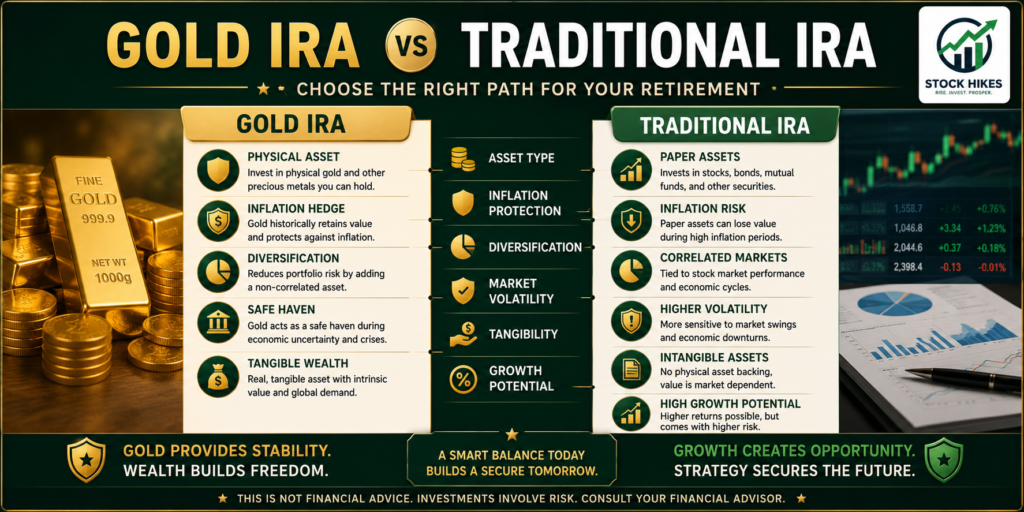
| Feature | Traditional IRA | Gold IRA |
|---|---|---|
| Assets Held | Stocks, bonds, mutual funds | Physical precious metals |
| Tax Benefits | Yes | Yes |
| Storage | Brokerage account | IRS-approved vault |
| Fees | Generally lower | Usually higher |
| Liquidity | Easier to sell | Slightly less liquid |
| Inflation Protection | Limited | Historically stronger |
A Gold investment is usually best used as part of a diversified retirement strategy rather than as a complete replacement for traditional investments.
Benefits of a Gold IRA

Inflation Protection
Gold has historically maintained value during periods of inflation and currency weakness.
Portfolio Diversification
Adding precious metals can reduce dependence on the stock market and improve diversification.
Protection During Market Volatility
Gold often performs differently from stocks during economic downturns, which may help balance risk.
Tangible Asset Ownership
Unlike paper investments, gold is a physical asset with long-term historical value.
Tax Advantages
Gold IRAs provide the same tax-deferred or tax-free growth opportunities as traditional retirement accounts.
Risks and Downsides of a Gold IRA
While Gold IRAs offer benefits, understanding the real Gold IRA pros and cons is important because these accounts also come with certain risks and drawbacks.
Higher Fees
Gold IRAs usually involve:
- Setup fees
- Custodian fees
- Storage fees
- Transaction fees
No Passive Income
Gold does not produce dividends or interest like stocks and bonds.
Price Volatility
Gold prices can rise and fall significantly over short periods.
More Complex Setup
Gold IRAs require specialized custodians and approved storage facilities.
Lower Liquidity
Selling physical gold is generally less convenient than selling stocks or ETFs.
Who Should Consider a Gold IRA?
A Gold IRA may be suitable for investors who:
- Want retirement diversification
- Are concerned about inflation
- Prefer tangible assets
- Already have traditional retirement accounts
- Have a long-term investment horizon
It may not be ideal for investors seeking aggressive growth or quick access to cash.
Many financial professionals recommend limiting precious metals to approximately 5%–15% of an overall retirement portfolio.
How to Open a Gold IRA
Step 1: Choose a Gold IRA Custodian
Select a reputable company experienced in self-directed IRAs and precious metals.
Step 2: Open Your Account
Complete the application and choose between a Traditional or Roth structure.
Step 3: Fund the Account
You can fund a Gold IRA through:
- Direct contributions
- IRA transfers
- 401(k) rollovers
Step 4: Select Approved Metals
Choose IRS-approved gold or other precious metals.
Step 5: Arrange Secure Storage
Your metals must be stored in an IRS-approved depository.
Gold IRA Fees Explained
Typical costs include:
| Fee Type | Typical Cost |
|---|---|
| Setup Fee | $50–$300 |
| Annual Custodian Fee | $75–$300 |
| Storage Fee | $100–$300 |
| Transaction Fee | $25–$50 |
| Transfer/Wire Fee | $25–$50 |
Before opening an account, review all fee disclosures carefully and compare providers.
Understanding Gold IRA Rollovers
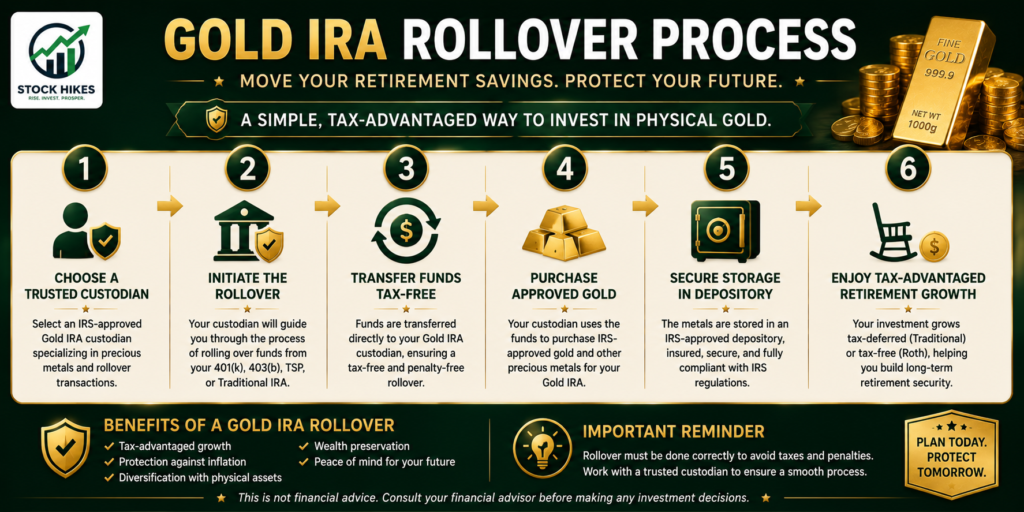
A Gold IRA rollover moves retirement funds from an existing account into a Gold individual retirement account.
Direct Rollover
Funds move directly between custodians. This is usually the safest and simplest option.
Indirect Rollover
You receive the funds personally and must redeposit them within 60 days to avoid taxes and penalties.
Most investors prefer direct rollovers because they reduce paperwork and IRS complications.
Important IRS Rules for Gold IRAs
To maintain tax advantages, this must follow IRS regulations.
Key Rules Include:
- Only approved metals are allowed
- Metals must meet purity standards
- Home storage is prohibited
- Assets must remain in an approved depository
- Contribution limits apply
- Traditional IRAs require minimum distributions beginning at age 73
Violating these rules can trigger taxes and penalties.
Common Gold IRA Mistakes to Avoid
Choosing the Wrong Custodian
Research the company’s reputation, fees, reviews, and customer service before opening an account.
Storing Gold at Home
IRS rules generally prohibit home storage for IRA metals.
Overinvesting in Gold
Avoid putting your entire retirement portfolio into precious metals.
Ignoring Fees
Long-term fees can significantly reduce investment returns.
Falling for Aggressive Sales Tactics
Be cautious of companies using fear-based marketing or unrealistic promises.
Is a Gold IRA safe?
It can provide long-term stability when managed properly through a reputable custodian and approved storage facility.
Can I keep Gold IRA metals at home?
No. IRS rules require IRA metals to remain in an approved depository.
How much gold should I own in retirement?
Many experts suggest allocating 5%–15% of a diversified retirement portfolio to precious metals.
Are Gold IRAs tax-free?
Traditional Gold IRAs grow tax-deferred, while Roth Gold IRAs may provide tax-free withdrawals in retirement.
What happens when I retire?
You can either:
Take physical possession of the metals
Sell the metals and receive cash distributions
Taxes depend on the type of IRA you own.
Final Thoughts
A Gold Individual Retirement Account is not a guaranteed path to wealth, but it can be a useful tool for diversification and long-term retirement protection.
For investors concerned about inflation, economic uncertainty, or market volatility, holding a small portion of retirement savings in precious metals may provide additional peace of mind.
Before opening an account:
- Compare multiple custodians
- Understand all fees
- Review IRS rules carefully
- Consider speaking with a financial advisor
A balanced retirement strategy is usually stronger than relying entirely on one type of investment.
Disclaimer
This article is for educational purposes only and should not be considered financial, legal, or tax advice. Always consult a qualified financial professional before making investment decisions.