


For retirement investors holding $25,000 or more over a 10+ year horizon, a Gold IRA generally outperforms physical gold on an after-tax basis—saving up to 28% in federal collectibles capital gains taxes—provided annual custodian and depository fees stay flat ($200–$300/year) rather than percentage-based. Conversely, for allocations under $15,000 or short-term emergency liquidity, direct physical bullion avoids recurring account overhead and early withdrawal penalties.
Educational fee & tax structure audit—not personalized financial or tax advice.
Key Quantitative Audit Findings:
- The Tax Wedge: Physical gold held outside a retirement account is classified by the IRS as a collectible, subjecting long-term gains to a maximum 28% federal capital gains rate (plus 3.8% NIIT for high earners)—higher than the 15%–20% rate on stocks.
- The Break-Even Threshold: At standard flat custodian and depository fees of $250/year, a $10,000 Gold IRA suffers a 2.50% annual fee drag, making physical gold cheaper. At $50,000, that drag drops to 0.50%, allowing tax-deferred or tax-free (Roth) compounding to outweigh annual fees.
- Liquidity vs. Compliance: Physical gold settles in 24–48 hours with a local or online dealer, whereas Gold IRA distributions before age 59½ trigger ordinary income tax plus a 10% IRS early withdrawal penalty.
Gold IRA vs. Physical Gold: At-a-Glance Comparison
While both options track the underlying spot price of gold, the legal wrapper dictates your net return, storage liability, and exit tax bill.
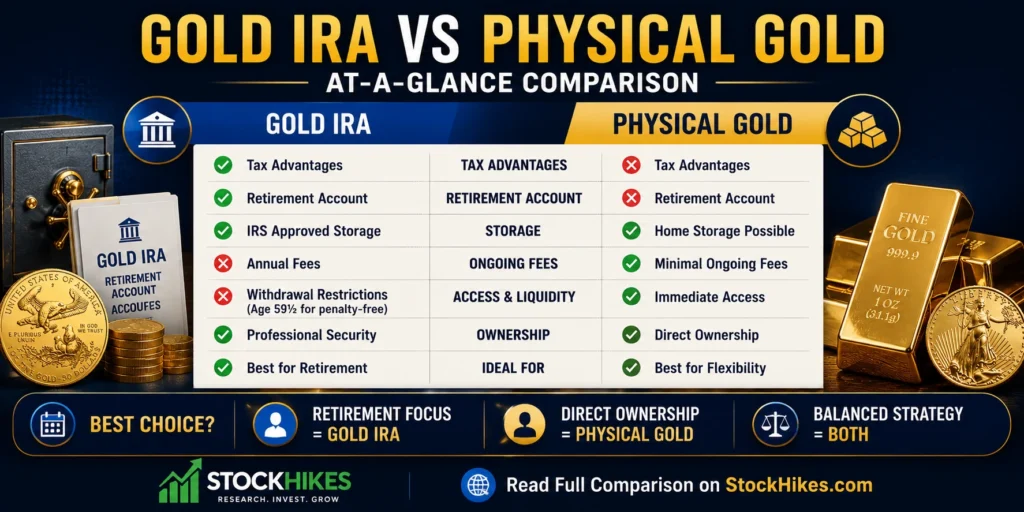
| Audit Metric | Gold IRA (Self-Directed) | Physical Gold (Direct Ownership) |
| Legal Ownership | Held by an IRS-approved custodian for your benefit | 100% direct personal ownership |
| Storage Mandate | Mandatory IRS-approved insured depository (home storage prohibited) | Home safe, bank safe deposit box, or private vault |
| Metal Purity Rules | Strict IRS minimums: .995+ gold (American Gold Eagle at .9167 exempt) | Any coin, bar, or bullion purity |
| Setup & Annual Fees | $50–$80 setup + $175–$300/yr flat custodian & storage fees | $0 account fees ($150–$400/yr optional private vault & insurance) |
| Dealer Spread / Markup | 3%–8% on IRA-eligible coins; 1%–3% on bars | 3%–8% on retail coins; 1%–3% on bullion bars |
| Tax Treatment | Tax-deferred (Traditional) or 100% tax-free (Roth) growth | Taxed upon sale at up to 28% IRS collectible rate |
| Liquidity & Access | Custodial liquidation; 10% penalty before age 59½ | Immediate sale to any bullion dealer; no age restrictions |
| Mandatory Withdrawals | Subject to Required Minimum Distributions (RMDs) at age 73 | None—hold indefinitely or pass directly to heirs |
| Best Mathematical Fit | 401(k)/IRA rollovers ($25,000+) with a 10–25 year horizon | Emergency hedge ($5,000–$15,000) or direct-access buyers |
10-Year Cost & Tax Math: $50,000 Allocation Model
Most comparisons ignore how fixed annual fees interact with tax drag over a decade. Below is a mathematical comparison assuming a $50,000 initial allocation, a 4% dealer spread ($2,000) on entry, and 7% annualized gold appreciation over 10 years (growing gross metal value to ~$94,420):
| Cost & Tax Component (10-Year Horizon) | Gold IRA (Roth / Tax-Free) | Gold IRA (Traditional) | Physical Gold (Home Safe) |
| Initial Purchase Allocation | $50,000 | $50,000 | $50,000 |
| Upfront Dealer Spread (4%) | -$2,000 | -$2,000 | -$2,000 |
| 10-Year Custodian & Storage ($250/yr) | -$2,500 | -$2,500 | $0 (Self-insured risk) |
| Gross Value at Year 10 (7% CAGR) | $94,420 | $94,420 | $94,420 |
| Exit Tax on $46,420 Gain | $0 (Qualified Roth) | Taxed at retirement bracket | -$12,998 (28% collectible rate) |
| Net After-Tax & Fee Value | $91,920 | $80,780 (at 24% bracket) | $81,422 (before insurance) |
The Takeaway: Even after paying $2,500 in cumulative depository and custodian fees over 10 years, a Roth Gold IRA preserves $10,498 more net wealth than physical gold held in a taxable personal account—simply by eliminating the 28% IRS collectibles tax.
Audit Your Own Numbers: Want to test how flat vs. percentage-based custodian fees affect your exact rollover balance? Run your figures in ourInteractive 10-Year Gold IRA Fee & Markup Calculator.
Core Structural Differences Every Investor Should Verify
1. IRS Storage & Purity Compliance
A Gold IRA is a self-directed individual retirement account governed by IRC Section 408(m). You cannot store IRA metals at home or in a personal bank deposit box—doing so is treated by the IRS as a full taxable distribution plus a 10% early withdrawal penalty if you are under 59½. Metals must be shipped directly to an approved depository (such as Delaware Depository or Brink’s) under either commingled (~$100–$150/yr) or segregated (~$150–$300/yr) storage.
2. Liquidity Speed vs. Institutional Security
- Physical Gold: You hold 1 oz coins (American Gold Eagle, Buffalo, Canadian Maple Leaf) or 1 oz–10 oz bullion bars directly. While you can sell them locally in a single afternoon without third-party approval, you bear 100% of the theft risk—and standard homeowner insurance policies rarely cover more than $1,000–$2,500 in bullion without an expensive specialty rider.
- Gold IRA: Selling requires submitting a liquidation order through your custodian, typically settling in 3–5 business days. In exchange, your metals sit inside a Class-3 vault backed by institutional all-risk insurance.
3. Required Minimum Distributions (RMDs)
Traditional Gold IRAs are subject to RMDs starting at age 73. Because physical coins and bars cannot be easily divided into exact dollar amounts, retirees must either sell a portion of their metals for cash each year or take an “in-kind” distribution (having the physical coins shipped home and paying income tax on their fair market value). Roth Gold IRAs have no RMDs during the owner’s lifetime.
Decision Framework: Which Structure Fits Your Portfolio?
Choose a Gold IRA If:
- You Are Rolling Over Existing Retirement Funds: Moving funds from an old 401(k) or Traditional IRA via a direct trustee-to-trustee transfer incurs zero tax withholding and preserves tax-sheltered status.
- Your Allocation Exceeds $25,000: At $25,000+, fixed annual fees (~$200–$250/yr) stay below 1.0% annually while shielding gains from the 28% collectibles tax.
- You Want Institutional Vault Security: You prefer regulated depository custody over managing home safes and private insurance riders.
Choose Physical Gold If:
- Your Investment Is Under $15,000: On a $10,000 purchase, a $250 annual IRA fee equals a 2.5% yearly drag—eroding gold’s inflation-hedging power.
- You Prioritize Immediate Crisis Access: You want bullion in hand outside the banking system with zero custodial processing delays[cite: 13, 17].
- You Are Investing Post-Tax Cash Short-Term: You may need to liquidate within 1–5 years and cannot lock capital until age 59½[cite: 13, 17].
The Hybrid 70/30 Allocation Approach
Many investors split their precious metals budget rather than choosing exclusively[cite: 18]:
- 70% in a Gold IRA (funded via 401(k)/IRA rollover) to capture tax-free or tax-deferred compounding on larger balances[cite: 18].
- 30% in Physical 1 oz Bullion Coins stored locally for immediate emergency liquidity[cite: 18].
Frequently Asked Questions (FAQ)
Is a Gold IRA safer than owning physical gold?
Neither is inherently “safer” — the risks are just different. A Gold IRA stores your metals in a professionally secured, insured depository, eliminating the risk of home theft. But it introduces custodian risk and regulatory risk. Physical gold at home eliminates third-party institutional risk but exposes you to theft and the limits of personal security. Physical gold in a private vault is arguably the most secure storage method of all, though it comes with its own fees and counterparty considerations.
Can I keep Gold IRA metals at home?
No. IRS rules prohibit storing Gold IRA assets at home or in a bank safe deposit box. All metals must be held at an IRS-approved depository. Attempting to keep Gold IRA metals at home is considered a distribution, which triggers taxes and penalties.
What are the tax benefits of a Gold IRA?
A Traditional Gold IRA allows tax-deferred growth — meaning you won’t owe taxes on gains until you take distributions in retirement, typically when you may be in a lower tax bracket. A Roth Gold IRA allows completely tax-free growth and withdrawals, making it powerful for younger investors expecting higher future tax rates.
Is physical gold easier to sell?
In some ways, yes. You can sell physical gold to any local coin dealer or bullion dealer at any time — there’s no custodian process to go through. However, selling physical gold requires finding a buyer, negotiating a fair price, and handling the transaction yourself. A Gold IRA liquidation goes through your custodian, which adds a step but also ensures compliance with IRS reporting requirements.
What types of gold qualify for a Gold IRA?
The IRS requires gold to be at least .995 fine (99.5% pure). Qualifying items include American Gold Eagle coins (which are the only exception to the purity rule at .9167 fine), American Gold Buffalo coins, Canadian Maple Leaf coins, Austrian Philharmonic coins, and gold bars from COMEX or NYMEX-approved refiners. Collectible coins, graded coins, and jewelry are not allowed.
How much gold should be in a retirement portfolio?
Most financial advisors suggest keeping between 5% and 15% of a retirement portfolio in gold or other precious metals. This range is enough to provide meaningful inflation protection and diversification benefits without over-concentrating in a single commodity that produces no income. The right percentage depends on your overall asset allocation, risk tolerance, and proximity to retirement.
Are Gold IRA fees worth paying?
For most long-term retirement investors, yes. The annual fees — typically $200–$600 per year, depending on the custodian — are offset by the tax benefits of holding gold in a retirement account. If you’re in a high tax bracket and plan to hold gold for many years, the tax savings from deferred or eliminated capital gains taxes can significantly outweigh the fee costs. However, for small account balances or short holding periods, the fees may not be justified.
Can retirees own both a Gold IRA and physical gold?
Yes, absolutely. Owning both is common among retirees who want the tax advantages of an IRA for the bulk of their gold exposure, while maintaining direct access to a portion of their physical gold for emergency liquidity. There are no rules prohibiting someone from holding a Gold IRA and separately owning physical gold coins or bars outside of any retirement account.
Disclaimer:
Disclaimer: StockHikes provides independent quantitative research and educational fee audits for informational purposes only and does not offer personalized financial, legal, or tax advice. Always consult a licensed CPA or fiduciary advisor before initiating an IRA rollover.
