

Inflation keeps eating away at your purchasing power. The stock market swings wildly from one quarter to the next. And somewhere in the back of your mind, there’s a nagging question: Is my retirement money actually safe?
If you’ve been wondering whether a Gold IRA could help protect your savings, you’re not alone. Thousands of Americans are asking the same thing. Gold has been a store of value for centuries, and during uncertain economic times, it tends to get a lot of attention.
But before opening one, it’s important to understand the real Gold IRA pros and cons. Like any retirement investment, a Gold IRA comes with both advantages and drawbacks. This guide breaks down both sides honestly — without hype or sales pressure — so you can decide whether a Gold IRA fits your long-term retirement strategy.
What Is a Gold IRA?
A Gold IRA is a type of self-directed Individual Retirement Account that lets you hold physical gold — and other approved precious metals — instead of (or alongside) the usual stocks, bonds, and mutual funds. If you want a more detailed beginner-friendly explanation, read our complete guide on What Is a Gold IRA and How It Works.
Here’s what makes it different from a regular IRA:
- You own physical metal. We’re talking actual gold bars or coins, not a gold-related stock or ETF.
- It’s self-directed. You (with the help of a custodian) choose what goes in the account.
- The IRS has specific rules. Not every gold coin or bar qualifies. The metals must meet purity standards set by the IRS.
- Your gold must be stored in an approved depository. You can’t keep it in your home safe — more on that later.
What Metals Are Allowed?
The IRS allows four types of precious metals in a self-directed IRA:
- Gold – must be at least 99.5% pure
- Silver – must be at least 99.9% pure
- Platinum – must be at least 99.95% pure
- Palladium – must be at least 99.95% pure
Common approved gold coins include the American Gold Eagle, the Canadian Gold Maple Leaf, and the American Gold Buffalo. Generic gold jewelry or collectible coins do not qualify.
How Does It Work?
You open a Gold IRA through a specialized custodian — a financial institution approved by the IRS to manage self-directed IRAs. That custodian helps you fund the account (either with new contributions or by rolling over funds from an existing 401(k) or traditional IRA), purchase the metals through an approved dealer, and arrange for storage at an IRS-approved depository.
Gold IRA Pros: The Benefits Worth Knowing
1. Hedge Against Inflation
When inflation rises, the dollar buys less. Your grocery bill goes up, your gas costs more, and the purchasing power of cash savings slowly shrinks.
Gold tends to hold its value over a long period of time, even as the dollar weakens. Think back to 2008 or 2020 — when the economy struggled, and stimulus money flooded the system, gold prices climbed. It doesn’t always move in perfect lockstep with inflation, but historically, gold has been a reliable long-term inflation hedge for retirement savings.
For retirees living on a fixed income, that kind of stability can be genuinely reassuring.
2. Portfolio Diversification
The old saying “don’t put all your eggs in one basket” applies to investing, too. Most Americans have retirement portfolios packed with stocks and bonds. That’s fine when markets are calm — but when stocks crash, those portfolios can lose 30%, 40%, or more of their value in a short time.
Gold often moves differently from stocks. When stock prices fall sharply, gold prices sometimes rise (or at least hold steady). This means adding gold to your portfolio can help soften the blow during a market downturn.
Diversification doesn’t eliminate risk, but it spreads it out — and that’s one of the most sensible things any long-term investor can do.
3. Ownership of Physical Assets
When looking at Gold IRA pros and cons, one of the biggest advantages is owning a physical asset instead of relying entirely on paper investments.
When you own stock, you own a small piece of a company — on paper. If the company struggles, the value of your investment can fall quickly.
With a physical gold IRA, you own something tangible. Gold has intrinsic value, doesn’t depend on a company’s earnings, and has been used as a store of wealth for centuries.
For investors who feel uncomfortable relying entirely on stocks and financial markets, physical gold can offer an added sense of stability and diversification within a retirement portfolio.
4. Long-Term Store of Value
Gold has maintained its purchasing power over very long time horizons. An ounce of gold in ancient Rome could buy a fine toga and sandals. Today, that same ounce of gold is worth enough to buy a quality suit.
That’s not a guarantee of future performance — nothing is. But it does reflect the metal’s track record as a durable store of value over centuries. For retirement planning, that historical context is worth considering.
5. Protection During Economic Uncertainty
Recessions, banking crises, geopolitical instability — these events tend to shake investor confidence in traditional financial assets. During times of extreme uncertainty, investors often “flee to safety,” and gold is one of the traditional safe-haven assets they turn to.
If you’re concerned about the long-term health of the U.S. economy or the global financial system, holding some gold in your retirement account may provide a sense of security that purely paper-based assets can’t.
6. Tax Advantages
Gold IRAs offer the same tax benefits as traditional or Roth IRAs, depending on which type you choose:
- Traditional Gold IRA: Contributions may be tax-deductible, and your investment grows tax-deferred until you withdraw in retirement.
- Roth Gold IRA: Contributions are made with after-tax dollars, but qualified withdrawals in retirement are completely tax-free.
These tax advantages are significant. They allow your gold investment to compound without the drag of annual capital gains taxes.
Gold IRA Cons: The Drawbacks You Need to Understand
1. Higher Fees
This is probably the biggest practical downside of a Gold IRA. Compared to a regular IRA at a brokerage, Gold IRAs cost significantly more to maintain. Here’s a breakdown of typical fees:
| Fee Type | Typical Range |
|---|---|
| Account setup fee | $50 – $300 |
| Annual custodian fee | $75 – $300/year |
| Storage fee | $100 – $300/year |
| Dealer markup on metals | 1% – 8% above spot price |
| Wire transfer/transaction fees | $25 – $50 per transaction |
| Account closure fee | $50 – $200 |
These fees add up fast. If you have a modest account balance, the annual costs can seriously eat into your returns. Always ask for a full fee schedule upfront — before you sign anything.
2. No Passive Income
Gold doesn’t pay dividends. It doesn’t earn interest. It just sits in a vault, hoping to be worth more when you sell it than when you bought it.
Compare that to dividend-paying stocks, bonds, or REITs, which generate income you can reinvest or use in retirement. With gold, your entire return depends on price appreciation — and that’s not guaranteed.
For retirees who need regular income from their portfolio, gold alone won’t cut it. It works better as a portion of a diversified portfolio, not as the whole thing.
3. Price Volatility
Yes, gold can be volatile. While it may be less volatile than individual stocks, it has seen significant price swings over the years.
Gold hit a high near $1,900 per ounce in 2011, then dropped to around $1,050 by 2015 — a decline of more than 44%. It recovered and exceeded those levels later, but that kind of multi-year drawdown isn’t comfortable for someone close to retirement.
Don’t assume gold always goes up. Over short to medium time horizons, the price can drop substantially.
4. Strict IRS Rules
The IRS has very specific requirements for Gold IRAs, and if you break the rules — even accidentally — the consequences can be severe.
Some of the key rules include:
- Only IRS-approved metals with specific purity levels are allowed.
- Your metals must be stored in an IRS-approved depository, not at home.
- You cannot take physical possession of the metals while they’re in your IRA (that counts as a distribution).
- Prohibited transactions can result in your entire account being treated as distributed — triggering taxes and penalties.
Navigating these rules requires a knowledgeable custodian and careful attention.
5. Liquidity Challenges
Selling gold from an IRA isn’t as simple as clicking “sell” on a brokerage app. The process typically involves contacting your custodian, instructing them to sell the metals, waiting for the transaction to process, and then receiving the cash.
This can take days or even weeks. If you need money quickly during a financial emergency, a Gold IRA isn’t going to be as accessible as a regular savings account or even a standard brokerage account.
6. Risk of Aggressive Sales Companies
This is an important warning: the Gold IRA industry includes some legitimate, trustworthy companies — and some that are not.
Some companies use high-pressure sales tactics, misleading advertising, and complex fee structures to take advantage of investors. Watch out for:
- Companies that push you to invest most or all of your retirement savings in gold
- Promotions promising “guaranteed” returns
- Vague or undisclosed fee structures
- Salespeople who create a sense of urgency
Always research any Gold IRA company thoroughly before doing business with them. Read independent reviews, check their rating with the Better Business Bureau, and look for complaints with your state’s financial regulator.
Gold IRA Pros And Cons: Quick Summary Table
| Feature | Pros | Cons |
|---|---|---|
| Inflation protection | Strong historical hedge | Not guaranteed every year |
| Diversification | Moves differently from stocks | Still subject to price swings |
| Physical ownership | Tangible, real asset | Must store in approved depository |
| Long-term value | Centuries of track record | Short-term can drop significantly |
| Economic protection | Safe haven in crises | Doesn’t generate income |
| Tax benefits | Same as traditional/Roth IRA | Subject to same withdrawal rules |
| Fees | Comparable setup to brokerage | Significantly higher ongoing costs |
| Liquidity | Can sell when needed | Process is slower than stocks |
| IRS rules | Established framework | Complex, easy to violate accidentally |
| Income generation | None | Stocks/bonds pay dividends/interest |
Gold IRA vs. Traditional IRA
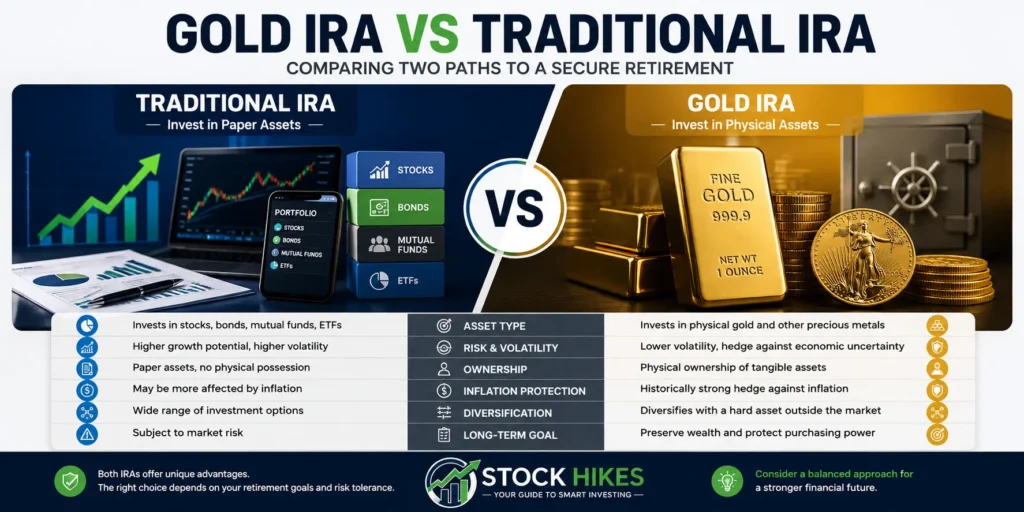
How does a Gold IRA actually compare to a regular IRA? Here’s a side-by-side look:
| Factor | Gold IRA | Traditional IRA |
|---|---|---|
| Primary assets | Physical gold/precious metals | Stocks, bonds, mutual funds, ETFs |
| Inflation protection | Strong | Moderate (depends on holdings) |
| Growth potential | Moderate (price appreciation only) | Higher (equities + compounding) |
| Income generation | None | Dividends, interest possible |
| Fee structure | Higher (custodian + storage) | Lower (typically fund expense ratios) |
| Liquidity | Lower (takes days to sell) | Higher (sell online in seconds) |
| IRS rules | Complex (storage, purity, approved custodians) | Straightforward |
| Best suited for | Diversification, inflation hedge | Long-term growth, income generation |
Most financial advisors suggest that gold should be a component of a diversified portfolio — not the entire retirement plan. The typical suggestion is somewhere between 5% and 15% of your total retirement assets in precious metals, though the right amount depends on your age, risk tolerance, and financial goals.
Who Should Consider a Gold IRA?
A Gold IRA isn’t the right fit for everyone. Here’s a realistic look at who it tends to benefit most — and who it might not suit.
It May Be a Good Fit If You:
- Are within 10–20 years of retirement and want to protect what you’ve built
- Are you concerned about inflation eating away at your purchasing power over time
- Already have a solid stock/bond portfolio and want to diversify further
- Prefer tangible assets and the idea of owning physical gold alongside paper investments
- Have a longer investment horizon and can ride out short-term price fluctuations
- Are not depending on investment income from your Gold IRA
It May NOT Be the Best Fit If You:
- Are just starting and need maximum growth potential from your retirement savings
- Have a small retirement account where the fees would eat up a large percentage of your returns
- Need liquidity and may need to access funds quickly
- Are you looking for income in retirement — gold won’t provide it
- Are you uncomfortable with price volatility in your precious metals investment
Common Gold IRA Mistakes to Avoid

Even well-intentioned investors make mistakes with Gold IRAs. Here are the most common ones — and how to steer clear.
Putting too much of your portfolio in gold. Gold works well as part of a diversified strategy. Going “all in” on gold concentrates your risk in a single asset class that pays no income and can be volatile. Most advisors recommend keeping gold to no more than 10–20% of your total retirement portfolio.
Ignoring fees. Setup fees, annual custodian fees, storage fees, and dealer markups can add up to hundreds of dollars per year. On a $20,000 Gold IRA, paying $500 a year in fees is 2.5% of your balance — gone before gold moves an inch. Always get a complete fee breakdown before opening an account.
Choosing an unreliable custodian. Not all custodians are equally trustworthy or experienced. Look for a custodian with a strong track record, transparent fees, and positive independent reviews. Verify they are properly registered and compliant with IRS requirements.
Misunderstanding IRS rules. Many new investors don’t realize that taking physical possession of their Gold IRA metals — even temporarily — counts as a distribution. That triggers taxes and possible early withdrawal penalties. Read the rules carefully and work with a custodian who explains them clearly.
Buying non-approved metals. Collectible coins, certain foreign gold coins, or gold that doesn’t meet IRS purity standards cannot be held in a Gold IRA. If you make this mistake, the IRS may treat the purchase as a distribution.
Are Gold IRAs Safe?
“Safe” means different things to different people. Let’s break it down honestly.
Storage security: Your physical gold is held at an IRS-approved depository — not a random warehouse. These facilities typically carry substantial insurance coverage and strict security protocols. Your metals are generally well-protected from theft or physical loss.
Market risk: Gold prices go up and down. Your Gold IRA can — and sometimes will — lose value in the short term. It is not a risk-free investment. There’s no FDIC insurance on gold like there is on bank deposits.
IRS compliance risk: If you work with a reputable custodian who follows IRS rules properly, this risk is manageable. But non-compliant transactions can result in serious tax consequences. This is why choosing the right custodian matters enormously.
Company risk: The company you work with matters. Legitimate custodians and dealers exist, but so do companies that cut corners or engage in misleading practices. Do your homework before committing.
Bottom line: A Gold IRA is a regulated investment vehicle with real protections in place. But it carries market risk, fees, and complexity that investors need to understand and accept before diving in.
Is a Gold IRA a good investment?
It depends on your financial situation and goals. A Gold IRA can be a useful tool for diversification and inflation protection — but it’s not a guaranteed path to wealth. Think of it as one piece of a well-rounded retirement strategy, not the whole picture.
Can I hold physical gold at home in a Gold IRA?
No. The IRS requires that gold held in an IRA be stored in an approved depository. If you take personal possession of your Gold IRA metals (even briefly), it’s treated as a distribution — which means you owe taxes on the amount and possibly a 10% early withdrawal penalty if you’re under age 59½.
How much gold should be in a retirement portfolio?
Most financial advisors suggest keeping precious metals between 5% and 15% of your total retirement portfolio. The exact amount depends on your age, risk tolerance, goals, and how close you are to retirement. There’s no one-size-fits-all answer.
What fees do Gold IRAs charge?
Gold IRA fees typically include a one-time account setup fee ($50–$300), annual custodian fees ($75–$300), annual storage fees ($100–$300), and dealer markups when buying or selling metals. Total annual costs often run $200–$600 or more per year, depending on the provider and account size.
Can I transfer my 401(k) into a Gold IRA?
Yes. This is called a Gold IRA rollover — and it’s one of the most common ways people fund a Gold IRA. You can roll over funds from a 401(k), traditional IRA, 403(b), or other eligible retirement accounts. When done correctly (within 60 days for an indirect rollover, or directly via trustee-to-trustee transfer), there are no taxes or penalties.
What happens when I retire and want to withdraw from a Gold IRA?
You have two options when you take distributions:
Cash out: Your custodian sells the metals and sends you the cash. Taxed as ordinary income (for a traditional Gold IRA).
Take in-kind distribution: You receive the physical gold itself. You’ll still owe taxes based on the value at the time of distribution, but you get to keep the metal.
Required Minimum Distributions (RMDs) apply to traditional Gold IRAs starting at age 73, just like traditional IRAs.
Is gold safer than stocks?
Neither is universally “safer.” Stocks have higher long-term growth potential but can drop sharply in the short term. Gold has a long history as a store of value, but it can also experience significant price declines and doesn’t generate income. Many investors hold both, using gold as a stabilizer in a stock-heavy portfolio.
Can Gold IRAs lose money?
Yes, they can. If you buy gold at a high price and the price falls before you sell, your account will be worth less. Additionally, fees charged each year reduce your net returns regardless of what gold prices do. Gold IRAs are not guaranteed to make money.
Conclusion: Is a Gold IRA Worth It?
A Gold IRA offers some genuinely compelling benefits for the right type of investor — particularly those who are concerned about inflation, want to diversify beyond paper assets, or are looking for a long-term store of value alongside their stocks and bonds.
But it also comes with real costs and complexity. Higher fees, no income generation, strict IRS rules, and the need to choose a trustworthy custodian all require careful thought before committing.
The key takeaways:
- Gold IRAs can be a smart diversification tool, but shouldn’t dominate your retirement savings
- The fees are real and significant — know what you’re paying
- Only IRS-approved metals stored in approved depositories qualify
- Research any custodian thoroughly — not all companies in this space operate with integrity
- A Gold IRA works best as part of a broader retirement strategy, not as a standalone solution
If you’re seriously considering opening a Gold IRA, start by consulting with an independent financial advisor (one who doesn’t earn commissions on what you buy). Get fee disclosures in writing, compare at least two or three custodians, and make sure the allocation fits your overall financial picture.
Gold has stood the test of time. Whether it belongs in your retirement account depends on your goals, your timeline, and your overall plan — and that’s a decision worth making carefully.
Gold can play a useful role in a diversified retirement strategy, but it isn’t a one-size-fits-all solution. Understanding the fees, risks, and IRS rules involved is essential before opening a Gold IRA.
Take time to compare your options, evaluate your long-term goals, and make sure any investment decision fits your overall retirement plan.
Disclaimer:
This article is for informational and educational purposes only and should not be considered financial or investment advice. Always do your own research and consult a qualified financial professional before making retirement investment decisions.