

Evaluating Gold IRA pros and cons comes down to a clear quantitative trade-off: a self-directed Gold IRA shields physical bullion gains from the 28% IRS collectibles tax and reduces equity drawdown risk during stagflation, but it introduces $175 to $300 in annual flat custodian and storage fees plus a 1% to 5% dealer spread. For U.S. retirement portfolios above $50,000 seeking a 5% to 15% inflation hedge, the tax-wrapper savings outweigh flat fees; for balances under $25,000, annual fee drag of 1.00% to 2.50% makes low-cost gold ETFs (0.10%–0.25% expense ratio) more cost-efficient.
Educational retirement & tax-wrapper research—not personalized financial, legal, or tax advice.
Quantitative Verdict: Gold IRA Pros and Cons at a Glance
- Primary Advantage (Tax Shelter + Uncorrelated Hedge): Eliminates the 28% federal collectibles capital gains tax (plus 3.8% NIIT) inside a Roth or Traditional wrapper while historically holding value during equity bear markets (2000–2002, 2008, 2020).
- Primary Drawback (Zero Yield + Fixed Fee Floor): Physical bullion pays 0% dividends or interest, and flat depository/custodian charges (~$250/yr) create heavy percentage drag on accounts under $25,000.
- Optimal Allocation Band: Institutional risk-parity frameworks generally cap precious metals at 5% to 15% of total investable retirement assets rather than concentrated all-in bets.
Gold IRA Pros and Cons: Side-by-Side Quantitative Matrix
Before rolling over funds from a 401(k) or Traditional IRA, compare the structural advantages and mathematical drawbacks of holding physical metals inside a self-directed retirement account:
| Evaluation Factor | Gold IRA Pros (Advantages) | Gold IRA Cons (Drawbacks) | FinTech Audit Benchmark |
| Tax Treatment | Tax-deferred (Traditional) or 100% tax-free (Roth) compounding; avoids 28% collectibles rate | Early withdrawals before age 59½ trigger income tax + 10% IRS penalty | Roth Gold IRA wins for 10+ year horizons |
| Inflation & Crisis Hedge | Tangible store of value with low/negative correlation to S&P 500 during stagflation | Can lag stocks during disinflationary booms and suffer multi-year drawdowns (-44% in 2011–2015) | Cap allocation at 5%–15% of portfolio |
| Annual Fee Structure | Reputable custodians charge flat fees ($175–$300/yr) regardless of account growth | High percentage drag (1.0%–2.5%/yr) on small balances under $25,000 | Break-even threshold starts at $35,000–$50,000 |
| Cash Flow & Yield | Protects purchasing power without corporate earnings or default risk | 0% dividend or interest yield; all return relies on spot price appreciation | Pair with dividend ETFs or T-Bills for income |
| Custody & Liquidity | Stored in insured, IRS-approved depositories (Delaware Depository, Brink’s) | No home storage allowed (IRC 408(m)); buyback wires take 3–5 business days | Keep 6–12 months emergency cash outside IRA |
The 5 Core Advantages of a Gold IRA (Pros)
- Elimination of the 28% IRS Collectibles Tax: Outside a retirement account, physical gold coins and bars are taxed by the IRS as collectibles at up to 28% federal capital gains (plus 3.8% Net Investment Income Tax for high earners). Inside a Roth Gold IRA, qualified withdrawals are 100% federal tax-free.
- Portfolio Drawdown Reduction: Because physical bullion has low historical correlation with U.S. equities, adding a 10% gold buffer to an equity-heavy portfolio dampens peak-to-trough losses during severe bear markets—helping retirees avoid sequence-of-returns risk.
- Direct Title to IRS-Approved Physical Bullion: Unlike paper derivatives or mining stocks exposed to corporate debt and energy costs, a Gold IRA holds allocated
.995+pure gold bars or sovereign coins (American Gold Eagles, Canadian Maple Leafs, American Gold Buffalos). - Penalty-Free 401(k) & IRA Rollover Funding: You can fund a Gold IRA via a direct trustee-to-trustee transfer from an old 401(k), 403(b), TSP, or Traditional IRA with zero tax withholding and no annual dollar cap.
- Institutional Vault Insurance: Metals held at IRS-approved depositories carry comprehensive all-risk insurance (typically underwritten by Lloyd’s of London) and remain segregated from the custodian’s corporate balance sheet.

The 5 Structural Drawbacks of a Gold IRA (Cons)
- Recurring Custodian and Storage Overhead: Unlike a $0-fee Fidelity or Schwab brokerage IRA, a Gold IRA requires an IRS-approved administrator and third-party vault—averaging $175 to $300/year plus a $50 to $100 setup fee. Run your exact balance in our Gold IRA 10-Year Fee & Dealer Markup Calculator before opening an account.
- Dealer Bid-Ask Spreads (Upfront Markup): Standard bullion bars and sovereign coins carry a 1% to 5% markup over live spot gold. Worse, aggressive sales reps pitch semi-numismatic or proof coins carrying 20% to 35% markups that take years just to break even[cite: 17, 18].
- Zero Passive Income or Compounding Yield: Gold produces no dividends, coupons, or cash flow. Over long expansionary periods, 100% productive equities outperform non-yielding bullion.
- Strict IRS Storage & Purity Prohibitions: Under IRC Section 408(m), storing Gold IRA metals in a home safe or personal bank safe deposit box—even through a “checkbook LLC”—is treated as an immediate taxable distribution plus a 10% early withdrawal penalty.
- Slower Settlement & RMD Logistics: Liquidating IRA bullion requires executing a dealer buyback and custodian wire (3 to 5 business days), and Traditional Gold IRAs remain subject to Required Minimum Distributions (RMDs) starting at age 73.
Gold IRA vs. Traditional IRA vs. Gold ETF: Which Fits Your Portfolio?
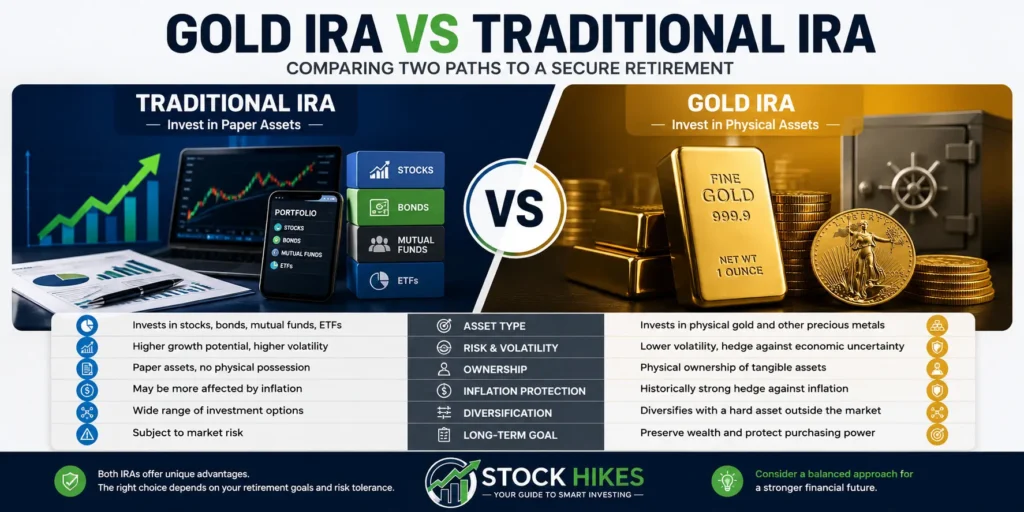
Choosing between physical bullion custody and paper gold depends on your balance size and liquidity needs—see our full Gold IRA vs. Physical Gold 10-Year Tax Audit and Gold and Inflation Historical Study for deeper modeling:
| Feature / Metric | Physical Gold IRA | Gold ETF in Brokerage IRA (e.g., GLDM) | Standard Traditional / Roth IRA |
| Underlying Asset | Allocated physical bullion bars & coins | Grantor trust shares backed by vaulted bullion | Stocks, index ETFs, bonds & Treasury funds |
| Annual Recurring Cost | $175 – $300/yr flat custodian + vault fee | 0.10% – 0.40% fund expense ratio ($0 IRA fee) | 0.00% – 0.03% on core index ETFs |
| Upfront Transaction Cost | 1% – 5% dealer spread over spot | $0 commission + penny bid-ask spread | $0 commission |
| Liquidity Speed | 3 – 5 business days (buyback + bank wire) | T+1 business day (instant market sell) | T+1 business day |
| Best Fit Profile | $50,000+ balances wanting direct physical metal custody | Under $35,000 balances wanting low-cost gold exposure | Core long-term wealth compounding & income |
Frequently Asked Questions (FAQ)
What are the biggest Gold IRA pros and cons?
The biggest advantages of a Gold IRA are tax-deferred or tax-free growth (avoiding the 28% IRS collectibles tax), direct ownership of IRS-approved physical bullion, and portfolio diversification during equity downturns. The main drawbacks are recurring custodian and storage fees ($175–$300/year), upfront dealer markups (1%–5% on bullion), zero dividend yield, and strict IRS depository rules[cite: 15, 17
Is a Gold IRA a good investment for retirement?
A Gold IRA can be an effective portfolio stabilizer when limited to 5% to 15% of a diversified retirement plan and funded with at least $35,000 to $50,000 to keep flat annual fees below 0.50% to 0.70%. Because gold generates no passive income, it works best alongside dividend-paying equities and Treasury securities rather than as a standalone retirement account.
Can I store Gold IRA coins at home in a safe?
No. Under Internal Revenue Code Section 408(m), all precious metals inside a Gold IRA must be held by an IRS-approved trustee or insured depository. Taking personal physical possession of IRA coins—including through a home-storage LLC—disqualifies the IRA and triggers immediate income taxes plus a 10% early withdrawal penalty if you are under age 59½.
How much does a Gold IRA cost per year?
Most reputable flat-fee custodians charge between $175 and $300 per year combined ($75–$150 for account administration and $100–$150 for commingled depository storage), plus a one-time $50 to $100 setup fee. Investors also pay a one-time dealer spread of 1% to 5% above spot price when purchasing IRS-approved bullion.
Should I buy a Gold ETF or open a physical Gold IRA?
If you are allocating less than $25,000 to $35,000 or want instant T+1 stock-market liquidity, buying a low-cost gold ETF like GLDM (0.10% expense ratio) inside an existing Fidelity or Schwab IRA is usually more cost-effective. If you are rolling over $50,000+ and specifically want direct legal title to segregated or allocated physical gold bars and coins, a flat-fee Gold IRA makes mathematical sense[cite: 15, 16, 17.
Disclaimer:
This article is for informational and educational purposes only and should not be considered financial or investment advice. Always do your own research and consult a qualified financial professional before making retirement investment decisions.
